

Songs in the Key of Life: Why It Still Matters
The first time we really heard “Isn’t She Lovely,” it was on a scratchy vinyl copy borrowed from a friend’s parents — the kind of record with a sleeve so worn you could barely read the spine. The opening harmonica line cut through the room, Stevie’s voice came in warm and joyful, and somewhere in the middle of that giggling baby recording, we understood we were listening to something that had escaped the limits of its own era. That moment sent us down a path we’ve never really left: digging through Stevie Wonder’s catalogue, learning the stories behind the songs, and eventually building this site. And no record has rewarded that obsession more than Songs in the Key of Life, the 1976 double LP that many fans — including us — consider the peak of his genius.
The Making of a Masterpiece
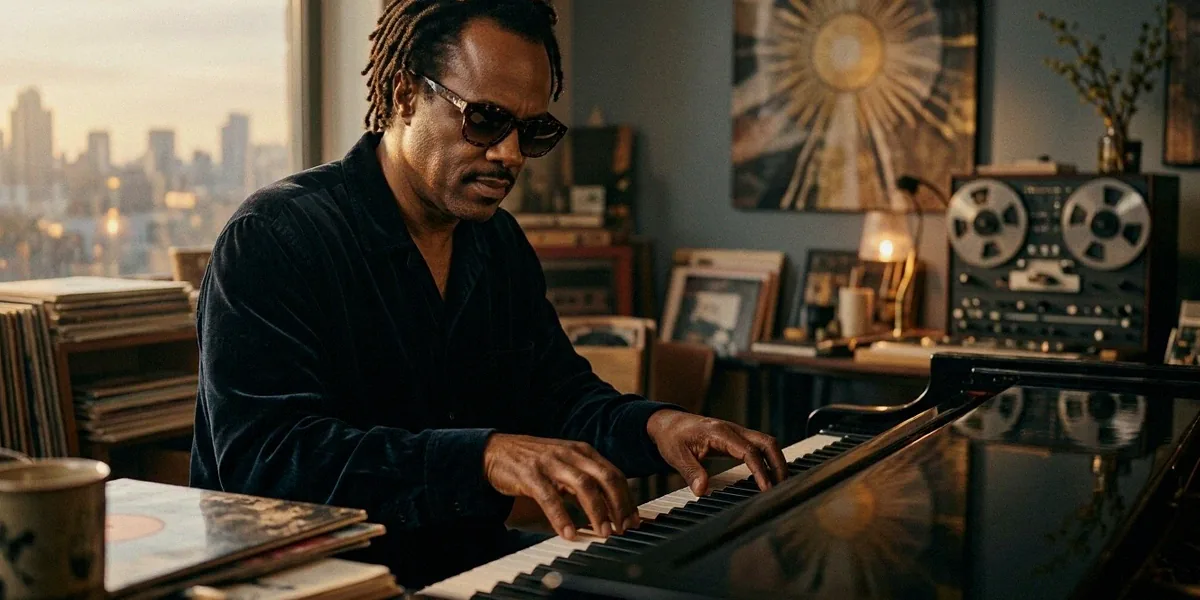
By 1974, Stevie Wonder had already pulled off one of the great creative runs in popular music: Music of My Mind, Talking Book, Innervisions, and Fulfillingness’ First Finale had all landed in just a few years, each one expanding what a soul record could be. But for the follow-up, he wanted more room. The result was an ambitious double LP with a bonus four-track EP — seven sides of music — recorded at Crystal Sound Studios in Los Angeles and released on September 28, 1976. It was a statement of scale as much as sound: Stevie wasn’t making singles, he was making a world.
Stevie’s Vision and Creative Control
By this point in his career, Stevie had won a hard-fought battle for creative control at Motown, and Songs in the Key of Life is what that freedom sounded like. He wrote or co-wrote virtually everything, produced the sessions, and played a staggering range of instruments himself — drums, keyboards, harmonica, bass. The album’s title hinted at its ambition: these weren’t just songs, they were chapters in a personal philosophy about love, faith, childhood, and social responsibility. When it won Album of the Year at the 1977 Grammy Awards, it felt less like a coronation and more like confirmation of something everyone already knew.
Collaborators and the Wonderlove Band
No one makes a record this size alone, and Stevie’s touring band, Wonderlove, was central to the process. The group brought a live, elastic energy to the studio, with players like bassist Nathan Watts anchoring grooves that could stretch out for minutes without losing their pulse. Longtime collaborators such as Wonderlove keyboardist and arranger Greg Phillinganes (who worked closely with Stevie in this era), drummer Raymond Pounds, and a host of guest musicians — including Herbie Hancock and George Benson — gave the sessions a jazz-inflected depth. Stevie also welcomed a children’s choir on “Isn’t She Lovely,” a detail that still makes the track feel like a family photograph you can hear.
Recording Innovations and Challenges
The recording process was famously sprawling. Stevie worked long, unconventional hours and pushed the studio to its limits, layering synthesizers, clavinet, and Fender Rhodes into textures that hadn’t really existed in soul music before. The TONTO synthesizer system — an enormous modular rig built by Malcolm Cecil and Robert Margouleff — helped shape the album’s otherworldly palette. The challenge wasn’t technical so much as editorial: with so much material, the hardest job was deciding what made the final sequence. The bonus EP, A Something’s Extra, was partly a solution to that problem — a place for the songs that didn’t fit the main narrative. The result is an album that feels generous rather than bloated, which is a rare thing for a double LP.
Track-by-Track: The Songs That Define the Album
You can’t really talk about Songs in the Key of Life without walking through it side by side. The sequencing matters — Stevie built the record like a setlist for the soul, moving from prayer to celebration to heartbreak and back again.
Side One: ‘Love’s in Need of Love Today’ to ‘Sir Duke’
The album opens with “Love’s in Need of Love Today,” a slow-build plea for compassion that still sounds painfully relevant. Then comes “Sir Duke,” Stevie’s tribute to Duke Ellington, built on one of the most joyful horn lines in pop history. It’s a song about the power of music itself, and it became a Top 40 hit in multiple countries, including Canada.
Side Two: ‘I Wish’ to ‘Ordinary Pain’
“I Wish” is pure nostalgia — a funk memoir about childhood, with a bassline that hip-hop producers have been borrowing for decades. “Ordinary Pain” shifts gears into a two-part meditation on betrayal and forgiveness, showing Stevie’s willingness to let a song be messy and unresolved.
Side Three: ‘Isn’t She Lovely’ to ‘As’
“Isn’t She Lovely,” written for his daughter Aisha, is probably the most universally loved track on the record — a song so buoyant it’s been played at weddings, in commercials, and in countless cover versions. “As” closes the side with one of Stevie’s most poetic lyrics: “As around the sun the earth knows she’s revolving…” It’s a love song that keeps expanding outward until it’s about the whole universe.
Side Four: ‘Another Star’ to ‘Easy Goin’ Evening’
“Another Star” is a Latin-flavored dance track that shows how effortlessly Stevie could move between styles, while “Easy Goin’ Evening” winds the album down with a gentle instrumental. Listening to the whole thing in order, you get a sense of an artist who refused to pick one mood — and who trusted his audience to follow him everywhere.
It’s also worth noting how far Stevie had come. Compare the lush, philosophical Songs in the Key of Life to “My Cherie Amour,” his sweet 1969 hit, and you can hear the entire arc of his evolution: from teenage Motown craftsman to self-contained auteur. Both songs are unmistakably his, but only one of them could have contained multitudes on this scale.
Why It Still Matters Today
Nearly five decades on, the album hasn’t aged into a museum piece. It’s still being sampled, studied, and played at protests and weddings alike.
Musical Influence on Modern Artists
If you listen to modern R&B and hip-hop, you’re hearing Songs in the Key of Life whether you know it or not. Drake sampled Stevie Wonder’s “Do I Do” in his song “Doing It Wrong,” a direct line between 1980s Stevie and 2010s Toronto. The Weeknd has cited Stevie Wonder as a major influence on his music, particularly in how he blends vulnerability with sonic ambition. And the list goes on — from Kendrick Lamar to Janelle Monáe, artists keep returning to this record because it gives them permission to be both personal and political in the same breath.
Social and Political Resonance
Songs like “Village Ghetto Land” and “Love’s in Need of Love Today” were written in the mid-1970s, but they could have been written last week. Stevie’s willingness to address poverty, racism, and spiritual longing — without ever sounding like he was lecturing — remains a model for any artist who wants to say something real.
Timeless Themes of Love and Justice
What holds the album together is its belief that love and justice aren’t separate causes. “As” is a love song, but it’s also a song about the order of the universe. “Isn’t She Lovely” is a lullaby, but it’s also a celebration of new life in a world that often feels hostile to it. That duality is why the record keeps finding new listeners.
Canadian Connections and Legacy
Stevie Wonder’s relationship with Canada runs deep, and it’s part of why this album feels so close to home for us.
Stevie Wonder’s Canadian Tours
Stevie Wonder performed at Massey Hall in Toronto multiple times, including a legendary 1970s concert that many Canadian fans still talk about. Massey Hall’s intimate acoustics and Stevie’s live-band energy made for a perfect match. More recently, he’s appeared at festivals like the Montreal Jazz Festival, where he’s drawn massive crowds and reminded audiences that his catalogue is as much a live experience as a recorded one.
Canadian Artists Inspired by Stevie
It’s not just Drake and The Weeknd. Canadian musicians across genres — from jazz players to indie songwriters — cite Stevie Wonder as a touchstone. His influence shows up in the way Canadian R&B artists phrase a melody, in the way producers layer keys, and in the willingness of Canadian songwriters to write about both love and social issues in the same song.
The Album’s Reception in Canada
Songs in the Key of Life was a commercial and critical success in Canada, charting well and earning steady radio play for “Sir Duke” and “I Wish.” Canadian critics praised its ambition, and it became a staple of record collections from Vancouver to Halifax. Today, it’s still a frequent entry in Canadian “greatest albums” lists and a reliable seller at independent record shops across the country.
Our Personal Reflections
We started this site because we couldn’t stop talking about this record. It’s the kind of album that makes you want to share it, argue about it, and play it for anyone who’ll listen.
Favorite Tracks and Moments
- “Sir Duke” — the horn arrangement still gives us chills every single time.
- “Isn’t She Lovely” — the baby giggles, the harmonica, the pure joy.
- “As” — the lyric that makes us believe in something bigger.
- “I Wish” — the bassline we hum at least once a week.
- “Another Star” — the track that proves Stevie could do anything.
What the Album Means to Us
For our team, Songs in the Key of Life is proof that popular music can be ambitious without being cold. It’s a record that takes its listeners seriously — that assumes we can handle complexity, sadness, and joy all at once. It’s also a reminder that Stevie Wonder’s genius wasn’t just in his voice or his songwriting, but in his refusal to be limited by what a “soul album” was supposed to be.
Why We Keep Coming Back
Every time we return to it, we hear something new: a background vocal, a synth texture, a lyric we’d glossed over before. That’s the mark of a living document, not a nostalgia piece. It keeps teaching us.
Frequently Asked Questions
When was Songs in the Key of Life released?
It was released on September 28, 1976, on Motown’s Tamla label, and was recorded at Crystal Sound Studios in Los Angeles.
Did Songs in the Key of Life win any major awards?
Yes — it won Album of the Year at the 1977 Grammy Awards, one of the most prestigious honours in music.
Which modern artists have been influenced by Stevie Wonder?
Drake sampled Stevie Wonder’s “Do I Do” in his song “Doing It Wrong,” and The Weeknd has cited Stevie Wonder as a major influence on his music. Many other R&B, hip-hop, and pop artists continue to draw from his catalogue.
Has Stevie Wonder performed in Canada?
Absolutely. He performed at Massey Hall in Toronto multiple times, including a legendary 1970s concert, and has also appeared at the Montreal Jazz Festival.
What makes Songs in the Key of Life different from Stevie Wonder’s earlier albums?
Its scale and creative freedom. The double LP format, the bonus EP, the wide range of styles, and Stevie’s near-total control over writing and production all set it apart from earlier records like Talking Book and Innervisions.
Songs in the Key of Life isn’t just a classic — it’s a living document of Stevie Wonder’s genius that continues to inspire new generations of listeners, musicians, and fans. Whether you’re hearing “Isn’t She Lovely” for the first time or the hundredth, the album still has something to say.