
How Stevie Wonder Plays Harmonica and Keyboards: A Fan’s Deep Dive
We still remember the first time that harmonica intro on ‘My Cherie Amour’ came through the speakers — that warm, reedy cry that sounds less like an instrument and more like a voice confessing something. It’s the moment that turned a lot of us into lifelong Stevie Wonder fans. How does one person make a ten-hole piece of metal sound so human? And how does that same person sit down at a keyboard and build entire worlds of rhythm and harmony? On this page, we dig into both halves of Stevie Wonder’s instrumental genius — the harmonica and the keyboards — and trace how they shaped the sound of Motown, soul, and pop across six decades.
The Harmonica: Stevie Wonder’s First Voice
Before the hit records, before the synthesizers, there was a kid in Detroit with a harmonica in his pocket. Stevland Hardaway Judkins was born in Saginaw, Michigan in 1950 and grew up in Detroit, where he was singing in church and picking up instruments by ear before he turned ten. The harmonica came first. It was cheap, portable, and forgiving for a child who couldn’t read sheet music — you played it entirely by feel and breath. That physical relationship with the instrument is probably why it ended up sounding so much like him. When Berry Gordy signed him to Motown in 1961 at age eleven, the harmonica was already his signature, and you can hear it on early sides like ‘Fingertips’ and ‘Uptight (Everything’s Alright).’
Early Influences and the Chromatic Harmonica
Stevie’s harmonica heroes were blues players — Little Walter, Sonny Boy Williamson, Toots Thielemans — but he quickly moved past straight diatonic blues playing into something more harmonically ambitious. His instrument of choice for most of his career has been the Hohner chromatic harmonica, especially the Super Chromonica 64 and the 270. A chromatic harmonica has a slide that lets you access every note in the scale, which is why Stevie can play in any key, follow jazz changes, and quote bebop lines that a standard blues harp simply can’t reach. That choice matters: it’s the difference between a folk instrument and a solo voice that can sit next to a full orchestra.
Technique: Bending Notes and Creating Vocal-Like Phrases
Listen closely to ‘My Cherie Amour’ and you’ll hear what makes Stevie’s harmonica playing so distinctive. He bends notes with his throat and tongue, the same muscles a singer uses, which gives every phrase a vowel-like shape. He’ll hold a note just past where you expect it to stop, then drop it a half-step, as if he’s finishing a sentence with a shrug. On slower ballads he uses wide vibrato; on up-tempo Motown cuts he treats the harmonica almost like a percussion instrument, chopping short rhythmic stabs between vocal lines. If you want to study this seriously, here’s what we’d listen for:
- Throat vibrato — the pulse that gives long notes their emotional weight
- Tongue-blocking and bending — how he slides into pitches rather than hitting them head-on
- Phrase endings — the way he answers his own singing with the harp, call-and-response style
- Slide-work on chromatic models — the quick button pushes that let him move through jazz harmony
From Piano to Synthesizer: The Evolution of His Keyboard Sound
By his teens, Stevie was already a serious pianist. He studied classical repertoire, and Motown staffers have talked for decades about how fast he absorbed theory without being able to see the page. You can hear the classical chops in the block chords on ‘My Cherie Amour’ and in the dense voicings across ‘Talking Book’ and ‘Innervisions.’ But the big shift came in the early 1970s, when he started moving away from acoustic piano and into electric keyboards — a change that rewrote what soul music could sound like.
The Moog Years: ‘Songs in the Key of Life’ and Beyond
The most important moment in Stevie’s keyboard evolution is his use of the Moog synthesizer on ‘Songs in the Key of Life’ (1976), the double album that yielded ‘Isn’t She Lovely,’ ‘Sir Duke,’ and ‘As.’ He didn’t use the Moog as a gimmick — he used it as an orchestra, layering bass lines, brass-like stabs, and shimmering pads underneath real drums and real voices. Combined with his earlier work on ‘Innervisions’ and ‘Talking Book,’ that period cemented him as one of the first soul artists to treat synthesizers as a legitimate expressive tool rather than a novelty. Producers and keyboardists still study those records today.
Clavinet and Electric Piano Grooves
Alongside the Moog, Stevie leaned hard on the Hohner Clavinet and the Fender Rhodes electric piano. The Clavinet gives ‘Superstition’ its famously funky, percussive bite — that sound is a clavinet through a wah pedal, played with an aggressive right hand and a laser-precise left. The Rhodes, softer and bell-like, shows up on ballads and mid-tempo grooves where he wanted warmth instead of bark. Between these two instruments, Stevie essentially built the tonal vocabulary that every funk and R&B keyboardist has drawn from since.
How He Combines Harmonica and Keyboards Live
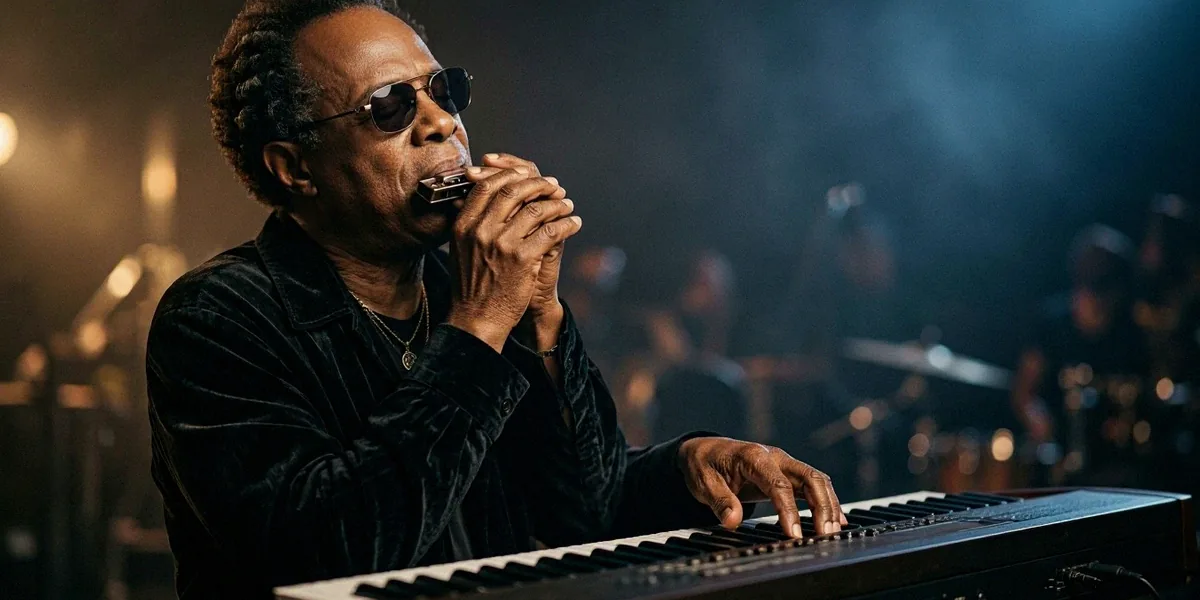
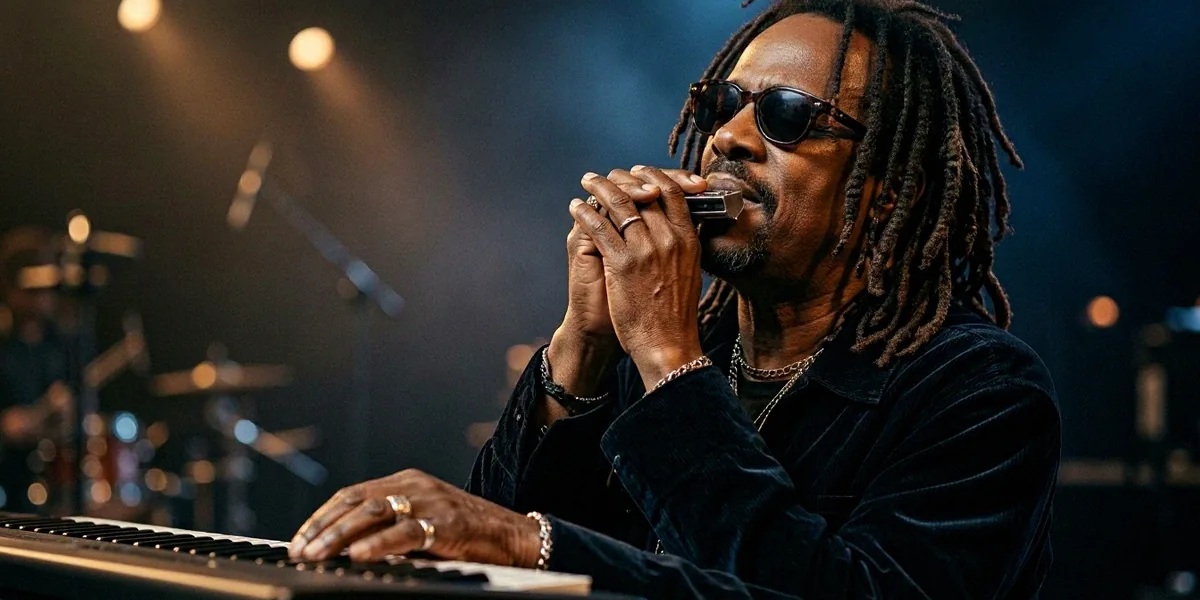
On stage, Stevie does something most multi-instrumentalists won’t even attempt: he plays harmonica and keyboards at the same time. The solution is a custom harmonica rack mounted around his neck, angled so he can lean into the harp while his hands stay on the keys. The effect during a live show is a single performer producing two complete musical voices at once. We saw the crowd at Toronto’s Scotiabank Arena in 2023 go completely silent during one of these passages — five thousand people watching a man hold two conversations at the same time.
The Harmonica Rack and Multi-Tasking
The rack itself is a simple piece of hardware, but timing is everything. Stevie has to plan when to inhale and exhale without disrupting his left-hand bass patterns, and he has to know exactly when to pull back from the keyboard to speak through the harp. On longer jams — think the extended vamp on ‘Living for the City’ — the transitions become a kind of choreography. Watch his shoulders during a solo: that’s where the coordination lives.
Improvisation and Audience Interaction
His live sets are rarely identical twice. He’ll call out key changes on the fly, stretch a groove an extra eight bars because the audience is feeling it, or break into a fragment of a song he hasn’t rehearsed in years. That spontaneity is only possible because he knows both instruments so deeply that they’re extensions of his hands, not tools he has to think about. It’s also why his band — some of whom have played with him for decades — stay on their toes every night.
Signature Techniques That Define His Sound
Strip away the hits and the awards, and what’s left is a set of identifiable techniques. You can hear Stevie in three notes on the radio, which is a rare thing for any musician working in any genre. Here are the ones we come back to most often.
Harmonica Vibrato and Tone Control
His vibrato is produced from the diaphragm and throat, not the hands, which is why it sounds organic rather than mechanical. He also varies his tone dramatically within a single phrase: bright and cutting on attack, breathy and soft at the release. On ‘My Cherie Amour,’ the harmonica is almost a duet partner with the vocal — same phrasing, same dynamic arc. That level of control requires years of listening to singers more than harmonica players.
Keyboard Voicings and Rhythmic Independence
On the keys, Stevie’s chord voicings are famously rich — extended chords with added ninths, elevenths, and sixths, often voiced in the middle of the keyboard so they don’t muddy the bass. His left hand operates almost like a drummer, laying down patterns independent of what the right hand is doing. That rhythmic independence is what lets him sing, play chords, and hold a groove while his harmonica line floats above it all.
Why Canadian Fans Connect with His Instrumental Genius
Stevie Wonder has toured Canada steadily for over five decades, and the response here has always been fierce. There’s a through-line from the Motown era, when Detroit’s sound bled across the border into Windsor and Toronto, to the present day, when Canadian audiences pack arenas every time he announces a date. We’ve been lucky enough to see him in some of the country’s best rooms.
Stevie Wonder’s Canadian Tour Highlights
His 2019 performance at the Montreal Jazz Festival is still talked about by everyone who was there — a set that stretched well past midnight and included rare deep cuts alongside the standards. Toronto has hosted him many times, most recently at Scotiabank Arena in 2023, where he showed off both the Hohner chromatic harmonica and a keyboard rig that covered everything from Rhodes to modern digital boards. Vancouver, Ottawa, and Hamilton have all had their nights too. If you’ve never seen him live, put it on the list.
Influence on Canadian Artists
Canadian musicians have been citing Stevie as a foundational influence for generations. You can hear it in the chord choices of Toronto R&B and soul artists, in the harmonic sophistication of Montreal’s jazz and pop scenes, and in the way younger producers across the country treat the Rhodes and Clavinet as essential colors rather than retro affectations. The Canadian music community has also honoured him through tribute shows, covers, and collaborations — a small repayment for the decades of inspiration he’s given us.
What makes Stevie Wonder’s instrumental work so enduring isn’t just that he plays two instruments well. It’s that he plays them with the same curiosity he’s brought to every decade of his career — from a Detroit kid blowing harmonica on a Motown B-side to a synthesizer pioneer reshaping what soul music could sound like on ‘Songs in the Key of Life.’ The harmonica and the keyboards are two halves of the same musical mind, and both are still teaching us something new.
Frequently Asked Questions
What kind of harmonica does Stevie Wonder play?
Stevie primarily plays Hohner chromatic harmonicas, particularly the Super Chromonica 64 and the 270. The chromatic design gives him access to every note in the scale, which is essential for the jazz-influenced phrasing he uses across his catalog.
Did Stevie Wonder really play the Moog synthesizer on ‘Songs in the Key of Life’?
Yes. The Moog synthesizer is a defining element of ‘Songs in the Key of Life’ (1976), and Stevie used it extensively as a compositional and textural tool — layering bass, brass-like stabs, and pads underneath live drums and vocals.
How does he play harmonica and keyboard at the same time?
He uses a custom harmonica rack mounted around his neck, positioned so he can lean into the harp while his hands remain on the keys. The coordination requires precise breath control and years of practice, especially during improvised sections.
Has Stevie Wonder performed in Canada recently?
Yes. He performed at Toronto’s Scotiabank Arena in 2023, and he headlined the Montreal Jazz Festival in 2019. He’s toured Canada consistently throughout his career, with stops in Vancouver, Ottawa, Hamilton, and other cities.
Which Stevie Wonder songs best showcase his harmonica playing?
‘My Cherie Amour’ is the classic starting point, along with early Motown sides like ‘Fingertips’ and ‘Uptight (Everything’s Alright).’ For deeper listening, check out live versions of ‘Living for the City,’ where he often stretches out on the harmonica between vocal sections.